


Jenna Barben was fishing in the lower Susquehanna when she caught this impressive Chesapeake Channa. Photo courtesy of Jenna Barben
There are plenty of fishing opportunities this week in Maryland waters from Ocean City surf to the cool waters of the western Maryland mountains.
Saturday, June 13 will be the second free fishing day this year where anglers over the age of 16 do not need a fishing license to legally fish in all of Maryland’s waters. July 4 will be the third and final day for anyone who does not have a fishing license to give fishing a try for the day. If you have a license, bring a friend!
As temperatures rise, the Striped Bass Summer Fishing Advisory Forecast is an awareness campaign aimed to reduce striped bass mortality from catch-and-release fishing in hot weather. The Department of Natural Resources will monitor temperature forecasts and issue a general recommendation for each day of the coming week.
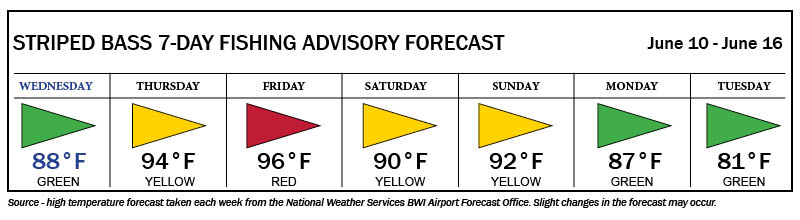
Striped Bass Fishing Advisory (June 10 – June 16)
Forecast Summary: June 3 – June 9
As reported by the NOAA buoys, main Bay surface and river mouth water temperatures have risen slightly to the mid 70s and will likely continue to rise all week. Smaller rivers and streams temperatures have also risen to the upper 70s. With warming waters, bottom oxygen levels are starting to decrease. Currently there is adequate oxygen in most Bay bottom waters except near Colonial Beach (Potomac River) and the Swan Point down to the Bay Bridge area.
Expect below average flows for most Maryland rivers and streams. Expect average clarity for most Maryland portions of the Bay and rivers. To see the latest water clarity conditions on NOAA satellite maps, check Eyes on the Bay Satellite Maps.
There will be above average tidal currents Thursday through Tuesday as a result of the new moon on Monday, June 15. This month we expect “king tides,” higher than normal high tides and lower than normal low tides. Expect horseshoe crabs to start appearing on local beaches with salinities above 6ppt for their spring spawning migration.
For more detailed and up-to-date fishing conditions in your area of the Bay, be sure to check out Eyes on the Bay’s Click Before You Cast.
Upper Chesapeake Bay
Anglers are fishing for a mix of striped bass, Chesapeake Channa, and blue catfish at the Conowingo Dam pool and the lower Susquehanna River this week. Cast into the turbine wash with heavy spinning tackle and a mix of topwater, paddletails, and cut bait. When fishing with topwater lures the best time to fish at the dam pool and the edges of the Susquehanna Flats are the early morning and evening hours.
Fishing for blue catfish remains good in the tidal rivers of the upper Bay, despite the larger female blue catfish actively spawning. There are plenty of smaller blue catfish available and if targeting the larger blue catfish, look for deep submerged structure. The mouth of the Susquehanna River and the Chester River hold some of the greatest populations of blue catfish.
Fishing for striped bass in some of the shallower waters of the upper Bay is good this week. Water clarity is good, water temperatures are a little more than 70 degrees, and some overcast weather is predicted, which is good. The waters around Pooles Island, Swan Point, Love Point, the mouth of the Patapsco/Key Bridge area, and Baltimore Harbor are all good places to jig with soft plastics or live-line spot.
Spot can be found in the Chester River near Hail Point, near the mouth of the Magothy River, the west side of the Bay Bridge and Sandy Point area. The spot are small and perfect for live-lining for striped bass. White perch can be mixed in at times and pieces of bloodworms are the premier bait.
Anglers are reporting that fishing for white perch has been tough at times, but the size of the perch is good. Most anglers are fishing near structure in the tidal rivers but some of the knolls in the upper Bay are starting to hold white perch as well.

Herb Floyd holds up a nice striped bass he caught and released in the shallow waters of the lower Choptank River. Photo by Herb Floyd
The Bay Bridge Piers continue to provide good fishing for striped bass this week. Anglers are anchoring up-current and drifting live spot, cut bait, or soft crab baits back to the pier bases. The first set of eight-legged bridge piers on the east side of the bridge tends to mark the 30-foot drop-off sweet spot for drifting baits back to the bridge piers. The rock piles are not to be overlooked either. Other anglers are experiencing good luck casting soft plastic jigs, bucktails, and paddletails to the pier bases in shallower areas of the bridge.
The Kent Narrows has been a good place to fish for striped bass for the last couple of weeks. Boats have been drifting in the current and jigging with soft plastics for striped bass. Fishing for white perch has also been good in the Kent Narrows. Eastern Bay, the Poplar Island breakwater, and the shallower waters of the lower Choptank and Little Choptank rivers. These are good places to cast poppers and similar topwater lures as well as paddletails during the morning and evening hours. The Bay shorelines on the western side are also providing good shallow water fishing. The cownose rays have arrived in force and can be pesky when they stir things up or get snagged. Jigging in the deeper waters is also a good way to target striped bass.
Live-lining for striped bass is becoming very popular as spot become more available. Many of the hard-bottom areas are holding small spot, croaker, and some white perch. Pieces of bloodworm on a bottom rig is what it takes to catch spot. The channel edge near Buoy 83 south to the False Channel is good for live-lining. On the western side of the Bay, Thomas Point is providing some live-lining and jigging success for striped bass. Bluefish are becoming more common and have been chewing up soft plastic jigs and live spot. Anglers are reminded that they must use non-offset circle hooks when targeting striped bass with live or cut bait.
Trolling is another option for striped bass anglers along the channel edges. Umbrella rigs, tandem rigged bucktails, and swim shads are common baits. Placing a Drone spoon or two in a trolling spread is a good way to target bluefish.
White perch are being found in the lower sections of the region’s tidal rivers near deep structure. Oyster bars, dock piers, and submerged rock walls provide the structure to which white perch gravitate. Grass shrimp is one of best and cheapest baits to use for white perch. They can be found in shallow grass beds, bulkheads and shallow backwater marsh edges and collected with a fine mesh net. Peeler crab and bloodworms will work well also and if you’re near a crab sheading business, sometimes you can purchase stills, which are crabs that die during the shedding process. Just make sure they’re somewhat fresh.
Lower Bay

This happy angler enjoyed jigging success in the lower Bay recently. Photo by Travis Long
Anglers in the lower Bay have several species of fish to choose from and a wide variety of locations to fish. Striped bass are being found in the shallow waters of the Bay and tidal rivers. The grass beds along the marshes of Tangier Sound, the Hoopers Island area, and locations on the western side of the Bay such as the St. Marys River are all good areas to cast topwater lures and paddletails. Most anglers are targeting striped bass, but speckled trout and bluefish can be part of the mix. Poppers and Zara Spooks are favored topwater lures. Water temperatures are now in the low 70s and anglers need to be diligent in practicing the best catch-and-release techniques to help conserve striped bass populations.
Jigging and live-lining is popular along the channel edges of the lower Potomac between St. Georges and Piney Point and St. Clements Island, along with various channel edges and 30-foot edges off Cedar and Cove points. Anywhere striped bass can be spotted suspended along the deep edges is the place for action. Bluefish will be muscling in on the action. As more spot become available, live-lining is taken center stage when targeting striped bass. Everyone has been talking about the water clarity for some time now. The lack of rainfall in the Chesapeake watershed has created very clear water conditions and many are switching to fluorocarbon leaders. Salinity values are also higher, so perhaps the Spanish mackerel and cobia will show up sooner this year.
The mouth of the Patuxent River, Cornfield Harbor near Point lookout, Cobb Island, Tangier Sound, and Hoopers Island are just a few places where spot can be found. Croakers and white perch will often be in the mix as well. The croakers tend to be of just legal size by an inch or so. Bloodworms are the most popular bait for spot, peeler crab will work for croakers and white perch, but bloodworms will catch them all.
Large red drum are providing exciting catch-and-release action in many areas of the lower Bay. During the morning and evening hours they can be encountered in the shallow waters of Tangier Sound and near Point Lookout and Hoopers Island. The deeper waters of Tangier Sound, near the Target Ship and Middle Grounds are good places to look for red drum. Watching for disturbed water and slicks or keeping an eye on a depth finder is how most anglers are finding them. Dropping soft crab baits to them or jigging are popular ways to catch them. There are also some black drum in the area. Be quick with those soft crab baits; there are a lot of cownose rays in the Bay this month.
Blue Crabs
Recreational crabbers are starting to see better crabs as more shed into being legal-sized. The middle and lower Bay regions tend to provide the best catches. Crabbers report crabs in 8 to 12 feet of water and smaller crabs in the shallower waters.

Michael Mackritis caught this big Chesapeake Channa near the Gunpowder/Bush River complex recently. Photo courtesy of Michael Mackritis
The spring trout stocking season is completed, and trout stocking will not resume until the October stockings. The Group 1 Delayed Harvest Areas have been open for anglers to keep five trout per day since June 1. The Group II Delayed Harvest Areas open next Tuesday, June 16. They include sections of the Casselman, the North Branch of the Potomac, and Youghiogheny rivers. Anglers are advised that only specific sections are open and to be familiar with which sections are open to harvest. The DNR website or page 25 of the Maryland Fishing and Crabbing Guide contains the specific information trout anglers will need to fish these areas.
Fishing for largemouth bass continues to be very good this month. Water temperatures are still cool enough that largemouth bass are feeding through most of the day. Largemouth bass will soon be shifting to a summer pattern of feeding at night and seeking cool shade during the day. Topwater frogs, buzzbaits, and chatterbaits are working well in or near grass beds. Spinnerbaits, paddletails, jerkbaits, and crankbaits can be good choices in transition areas. Wacky rigged worms, urchins, and similar soft plastic baits work well when dropped through grass mats or near structure.
Anglers are finding good fishing for Chesapeake Channa in many of the Chesapeake’s tidal rivers this month, despite spawning activity. The Conowingo Dam pool is always a good place to find them since it is a dead end to their travels. The Bush and Gunpowder rivers are favorites in the upper Bay; the Dorchester back waters and the Nanticoke River are Eastern Shore favorites. The tidal creeks of the Potomac and Patuxent offer good fishing on the lower western shore. A mix of buzzbaits, chatterbaits, frogs, and paddletails are popular lures to use.
The upper Potomac River is presently flowing low and clear but that could change with rain in the forecast. Deep Creek Lake is presently offering a wide variety of fish species for vacationing anglers. Yellow perch and bluegills can be caught off docks. Largemouth and smallmouth bass will be found seeking shade under undisturbed floating docks and northern pike can be found in the open waters near coves and deep grass lines.

Erik Dowell caught this beautiful summer flounder while drifting outside the inlet. Photo courtesy of Erik Dowell
The surf fishing scene at Assateague Island is starting to settle into a typical summer pattern. Kingfish are reported to be in the surf and clearnose skates are ever present. Anglers fishing large baits are catching and releasing a mix of striped bass and red drum and some inshore sharks. Bluefish tend to be the most common fish anglers are catching this week. Anglers are reminded if they are catching protected sharks, such as sand tigers, that the shark must remain in the water. Bringing it up on the sand for pictures – like sitting on them or holding their mouth open – is all very illegal by federal law.
At the Ocean City Inlet and Route 50 Bridge area, bluefish and striped bass are being caught by casting soft plastic jigs or drifting cut bait. Sheepshead are becoming more common around structure and are being caught on sand fleas. Flounder are always moving through the inlet, and the channels leading away from the inlet are excellent places to fish for them. Boat traffic is increasing so be careful when drifting in the channels.
Striped bass are being caught near the bridge piers of the Verrazzano and Route 50 bridges during the morning and evening hours. Casting soft plastic jigs and paddletails near the pier bases is the best way to target the striped bass. Most of the striped bass are a little short of the 28-inch minimum, but now and then one will be in the 28-31 inch slot.
Fishing for black sea bass has been good at the offshore wreck and reef sites. Limit catches are not as common as they were earlier in the season, but most anglers can catch enough for a couple of meals. Flounder can be part of the mix if targeted.
The offshore fishing at the canyons for yellowfin tuna and dolphin has been spotty at times and not all anglers are coming back to the docks with impressive catches. That could change in a day. Many captains are taking some time from trolling for deep drop fishing for golden and blueline tilefish to provide something to take home.
“An undisturbed river is as perfect as we will ever know, every refractive slide of cold water a glimpse of eternity.” – Thomas McGuane, 1990
Maryland Fishing Report is written and compiled by Keith Lockwood, fisheries biologist with the Maryland Department of Natural Resources.
The Forecast Summary is written by Tidewater Ecosystem Assessment Director Tom Parham.
A reminder to all Maryland anglers, please participate in DNR’s Volunteer Angler Surveys. This allows citizen scientists to contribute valuable data to the monitoring and management of several important fish species.
